
35 Years of EPAL – International anniversary conference brings together the logistics industry in Munich
EPAL press release of 23.06.2026
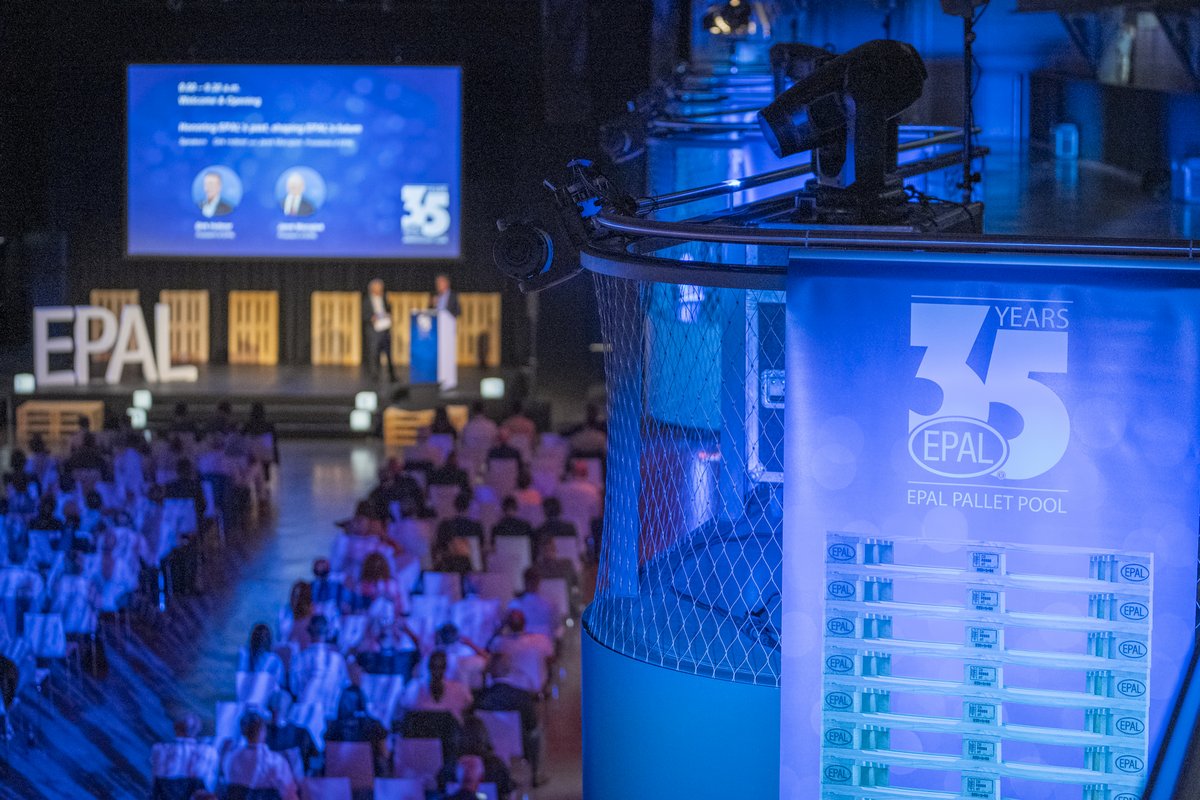
The European Pallet Association e.V. (EPAL) celebrated its 35th anniversary on 19 June 2026 with an international conference in Munich. 320 guests from industry, trade, logistics and associations met in Munich, where EPAL's founding meeting took place in 1991.
The anniversary conference was the highlight of the events to mark EPAL's 35th anniversary so far. What began in 1991 as an initiative for international quality assurance of Euro pallets has developed into the largest open pallet pool in the world over the next 35 years. Since EPAL was founded, almost two billion EPAL Euro pallets have been produced. Today, more than 670 million EPAL Euro pallets and more than 20 million EPAL box pallets are in use worldwide. EPAL pallets thus form the backbone of national and international supply chains.
The conference focused on the challenges and opportunities of tomorrow’s logistics. Speakers from the business, academic, and logistics sectors presented the latest developments in European legislation and the digitization and automation of logistics processes to conference participants—developments that are becoming increasingly important for pallet logistics and, consequently, for the EPAL pallet pool. For the 320 participants from nearly 30 countries—including attendees from China, India, and the United States—the anniversary conference served as an excellent platform for international exchange on the importance of standardization, quality assurance, and the reuse of EPAL pallets for the reliability and sustainability of goods and transport logistics.
Jarek Maciążek, President of EPAL:
"EPAL pallets are everywhere today. In every company, in many countries and often even in the private environment. EPAL's success is based on the trust of millions of users of EPAL pallets as well as the worldwide commitment of our licensees, the national associations and their employees. This strong network is not only the reason for EPAL's success story over the past 35 years, but also the basis for a successful future for the open EPAL pallet pool. Especially in a time of major economic, technological and ecological changes, our task is more relevant than ever. Digitization and automation, artificial intelligence and constantly growing sustainability requirements are changing the present and future of logistics. EPAL will continue to play an active role in shaping this change in the future – with innovative strength, clear standards and a firm commitment to taking responsibility for the economy and the environment."
A particular highlight of the conference was the panel discussion featuring some of the entrepreneurs who came up with the idea to found EPAL in 1991. Ulrich Feuersinger, Hans-Erich Schilling, and EPAL’s Honorary President, Robert Holliger, discussed how the opening of borders in Europe has transformed supply chains and pallet logistics. The quality assurance system for Euro pallets, which had been purely national until 1991, was no longer sufficient to meet the quality requirements for pallets set by users in industry, trade, and logistics within increasingly international supply chains. What none of the founders had anticipated at the time was that, with the establishment of an international association to organize the reuse of EPAL pallets, EPAL and the EPAL Pallet Pool would also become a role model for the circular economy and sustainability in logistics.
Dirk Hoferer, President of EPAL:
“EPAL’s success over the past 35 years is no coincidence. It is the result of the commitment and dedication of many people from numerous countries. Following its expansion in Europe, EPAL has been building its presence in China, Asia, and North America since 2006. The EPAL brand has thus become one of the best-known international brands in logistics and is is now seen as proof of the high quality, reliability and sustainability of pallets. We are proud of this development. My father, Albert Hoferer, was also one of EPAL’s founders, and so I have been able to follow EPAL’s development up close from the very beginning and have actively supported it since the mid-1990s. During this time, EPAL’s open reuse system has not only become an industry standard but has recently even been cited by the European Commission as an example of an open reuse system in accordance with the EU Packaging and packaging waste regulation.”
By choosing Munich as the venue for its anniversary conference, EPAL has come full circle. Munich was the site of EPAL’s founding meeting in early 1991. Today, EPAL is active in more than 40 countries, most of which were represented in Munich. In addition to numerous manufacturers and repairers of EPAL pallets, many industry partners also attended the EPAL conference to celebrate not only EPAL’s 35th anniversary but also the 35th anniversary of the EPAL pallet pool, which was established together with EPAL in 1991.
Following the conference programme, the festivities in Munich concluded with an evening anniversary celebration, during which the 320 participants were able to forge many more international contacts. The participants were unanimous in their view that a repeat of the conference should take place by EPAL’s 40th anniversary in 2031 at the latest.
About EPAL:
The European Pallet Association e.V. (EPAL), founded in 1991, is an international non-profit association and organises the open EPAL pallet pool. More than 1,700 EPAL licensees produce and repair EPAL Euro pallets and other EPAL load carriers. Currently, there are more than 670 million EPAL Euro pallets and around 20 million EPAL box pallets in circulation, making the EPAL pallet pool the world’s largest open pallet exchange pool.
With its principles of re-use, exchange, repair and recycling of pallets, the open EPAL pallet pool has been a prime example of a sustainable circular economy for more than three decades. EPAL wooden Euro pallets make a significant contribution to climate protection. They store CO2 , prevent waste, reduce the demand for timber and thus improve the CO2 footprint of users in industry, retail and logistics.
Further information for journalists:
European Pallet Association e.V. (EPAL)
Fabian Preuss (Communications Manager)
T +49 (0) 211 98 480 48 55
M +49 (0) 0152 55 33 62 88
fabian.preuss@epal-pallets.org